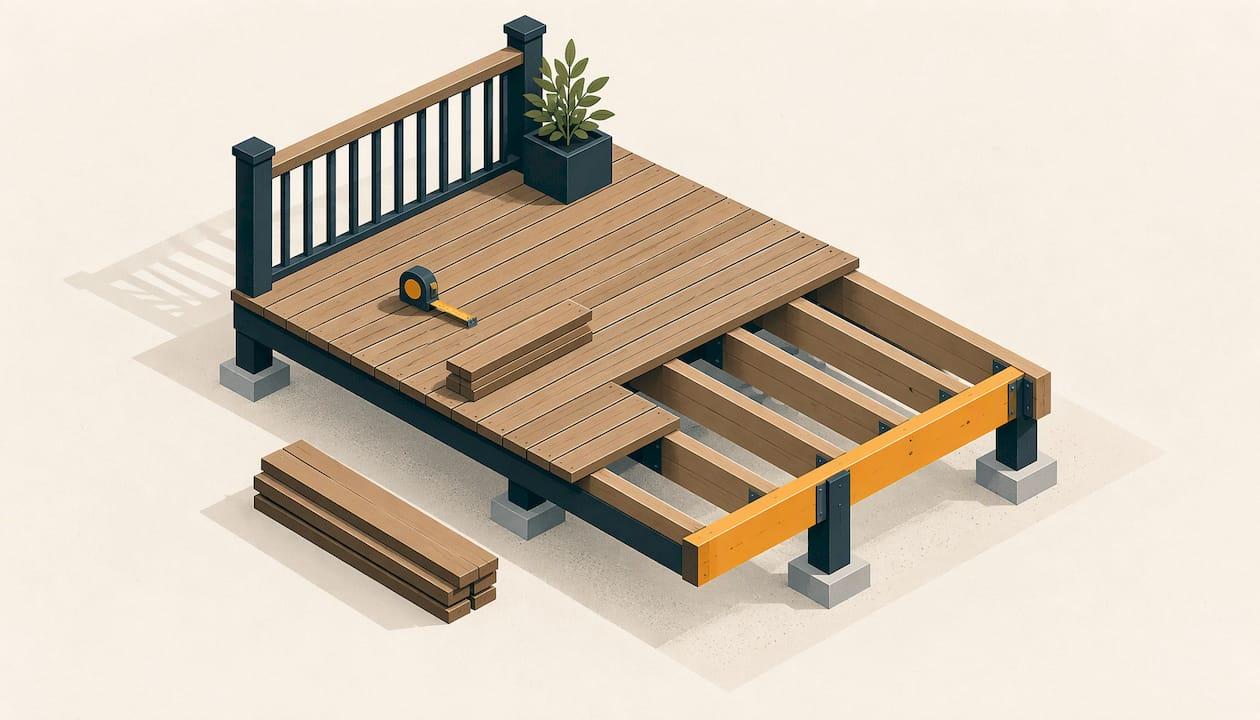
A good deck repair estimate names each problem, says where it is, states the repair method and materials, and explains how hidden damage will be priced. Most repairs nationally land between roughly $570 and $2,600, but the number matters less than whether the estimate comes from someone who actually inspected the structure. If you live in the Roanoke area, we offer free estimates on deck and porch work, with one point of contact from the first visit to the final walkthrough.
TL;DR
- Typical US deck repairs run about $570 to $2,600, with a national average near $1,465; structural work such as ledger boards costs far more.
- A written estimate should describe each problem and its location, the method, the materials, how hidden damage is priced, cleanup, timing, payment and warranty.
- An estimate is an informed approximation; a quote is a firm, accepted price. Either can change if rot is found under the surface, so agree on how that is handled before work starts.
- When repairs approach half the cost of a new deck, or the framing is failing, replacement may be the better value.
- In the Roanoke area, you can request a free deck and porch estimate.
Table of Contents
- What a deck repair estimate actually is
- What deck repairs cost in 2026
- What a written estimate should include
- Why the final price can differ from the estimate
- Repair or replace: what the estimate should tell you
- Safety and permits
- How to get a deck repair estimate that holds up
- Our deck and porch work in the Roanoke area
- Estimate checklist you can use today
- FAQ
- Sources
What a deck repair estimate actually is
An estimate is a contractor's best calculation of what the job will cost based on what they can see and measure. A quote is a more detailed, firm offer. As one contractor-pricing guide explains, estimates are approximate and usually not binding, so the final price can shift when more information appears, while a quote can become binding once you accept it.
For a deck, that difference is practical. The boards you can see are only part of the story. The joists, the ledger (the board that fastens the deck to your house), the posts and the footings sit underneath, and problems there change the scope. That is why the most useful estimate is one written after someone has walked the deck, probed the wood and looked underneath, not one given over the phone from a photo of the surface.

You will see both words used for the same document. What matters is what is on the page: scope, materials, price, and what happens if the scope changes.
What deck repairs cost in 2026
Published national figures vary because they average different jobs. Treat them as a sanity check for the estimate in your hand, not as a price.
| Repair | Typical national range | Source |
|---|---|---|
| Most deck repairs overall | $570 to $2,600 (average $1,465) | Lawn Love, 2026 |
| Replacing a few boards | about $200 to $900 | InspectandTest, 2026 |
| Joist repair | $150 to $400 per joist | InspectandTest, 2026 |
| Post replacement | $300 to $1,000 per post | InspectandTest, 2026 |
| New footings | $500 to $1,500 each | InspectandTest, 2026 |
| Ledger board replacement | $1,500 to $6,000 or more | InspectandTest, 2026 |
| Wobbly stairs | $200 to $2,000 | Bob Vila |
Other guides report different averages. Bob Vila's budgeting guide gives an average of $2,019 with a typical range of $859 to $3,321, and its damage-specific ranges are wide: rot from $300 to $5,000, sagging from $750 to $10,000. That spread is the point. Two decks with "a few bad boards" can be priced very differently once someone finds out why the boards went bad.
Why the same repair costs more on one deck than another
The main drivers behind the spread:
- Material. Replacement boards cost per square foot roughly $2 to $3.75 for pressure-treated pine, $3.40 to $6.00 for cedar and $8.20 to $13.30 for composite, according to Lawn Love's 2026 breakdown.
- Size and layout. An 8x8 deck takes far less work than a 15x20, and multi-level or second-story decks need more structural work, stairs and railings.
- Type of damage. Sanding and staining is a different job from rebuilding a joist or fixing the foundation of the deck.
- Permits and delivery. Permits typically run $225 to $500 when needed, and delivery fees at least $50.
- Season and location. Late winter and early spring tend to be the most expensive time to book, and urban areas cost more than rural ones, per the same guide.
What a written estimate should include
A one-line number is not an estimate. InspectandTest's checklist for a good deck repair quote is a useful standard to hold any document against:
- A written description of each problem and where it is on the deck.
- The repair method for each one.
- Material types and grades.
- Square or linear footage.
- Permit details.
- How hidden damage will be priced.
- Disposal and cleanup.
- Start date and duration.
- Payment schedule.
- Warranty terms.
Two more items are worth looking for. First, the estimate should show that the structure was actually inspected: ledger, posts, beams, joists, hangers, fasteners, decking, railings, stairs and footings. A contractor quote guide that draws on deck safety materials from the North American Deck and Railing Association makes this point: price should connect to real inspection findings. Second, anything not mentioned should be treated as not included until it is confirmed in writing.
Read the estimate line by line
When you have two or three written estimates, compare them item by item across demolition, surface prep, installation, materials, haul-away and cleanup, and the final punch list. Mark each item as included, excluded or unclear. The cheapest total is often the one that left out the railing, the haul-away or the footings. Getting two or three written estimates is, in InspectandTest's words, the single best protection against overpaying.
Why the final price can differ from the estimate
The usual cause is hidden damage. You cannot see rot inside a joist, a corroded fastener behind a board or a ledger that has been leaking water for years until the deck is opened up. A trustworthy estimate deals with that in advance instead of pretending it will not happen.
Look for these terms in writing:
- A unit price for hidden repairs. For example, a stated price per replaced joist or per board, so a surprise is priced by a rule you already agreed to rather than invented on the spot.
- A change-order process. The contractor documents the issue, shows you photos, explains how it changes the scope, gives a price, and gets your approval before continuing. That sequence is the one the contractor quote guide recommends, and it keeps you from learning about extra cost at the final invoice.
- A clear scope boundary. If the estimate covers "replace damaged boards," it should say who decides which boards are damaged and how they are counted.
If you are a property manager, this written trail also helps with owner approvals. Photos of what was found and a priced change order are easy to forward and file.
Repair or replace: what the estimate should tell you
A good estimate helps you decide this, not just price it. The question is what is under the surface.
Surface boards and railings are surface problems. Rot in several joists, a failing ledger or sinking footings are structural problems, which suggest the whole deck has been exposed to the same conditions, as InspectandTest explains. The same guide notes that a pressure-treated deck near the end of its typical 15 to 25 year life, with framing problems, is a stronger candidate for replacement than a younger deck with isolated damage. It also points out that when repairs climb past roughly half the price of a new deck, replacement often becomes the better value.
A worked example makes the logic concrete. Say you receive a repair estimate that adds up to $4,000 for a 15-year-old pressure-treated deck: new boards, two joists, a post and a footing. Replacement figures reported nationally run from $4,000 to $16,000 in one 2026 guide, but the real question is the condition of the rest of the frame. If the contractor found more soft wood while probing the remaining joists, you are buying repairs on a structure that will need more soon. If the damage is limited to one wet corner near a downspout, repair is sensible. Ask the contractor to say which of those two situations your deck is in, and to put it in writing.
For decks older than 10 years, Bob Vila notes that joists should be inspected, which is a good reason to schedule an assessment even when the surface looks fine.

Safety and permits
Deck failures are usually structural. One Virginia building code office notes that most decks fail at the ledger board where the deck attaches to the house, and it lists loose or corroded fasteners, decaying or sagging wood and damaged rails among the conditions that make a deck unsafe. That office also recommends an annual inspection, ideally in spring, and requires a permit for structural alterations or repairs in its city. Permit rules differ by locality, so the contractor should confirm what your city or county requires before work begins.
As a general rule, minor repairs typically do not need a permit, while increasing the deck size or adding utilities does require checking with local authorities. Ask whether the permit fee is in the estimate or listed separately, and who pulls it.
Structural work is the part to leave to a licensed, insured professional. If a guard rail moves when you lean on it, or stairs wobble, stay off that section of the deck until it has been looked at.
How to get a deck repair estimate that holds up
Here is a straightforward routine, with the points where it usually goes wrong.
- Walk the deck first and note what you see. Soft spots, loose railings, cracked boards, rusty fasteners, stains near the house wall, and any bounce. Take dated photos. Where it goes wrong: you describe only the visible damage, and the estimate prices only that.
- Ask for an on-site visit, not a phone number. The contractor should look underneath and at the ledger connection. Where it goes wrong: a quote based on photos treats the structure as sound when no one has checked it.
- Request the estimate in writing, itemized. Use the list above as your standard.
- Get the hidden-damage terms agreed before work starts. Unit prices and a change-order process, in writing.
- Confirm licensing, insurance and warranty. Ask for these in the document, not just in conversation.
- Compare line by line. Not total by total.
- Book outside the busy window if you can. Late winter and early spring are the most expensive time, according to Bob Vila's guide, so a fall or early winter repair can be easier to schedule.
We built our process around that routine. When you ask us for a deck or porch estimate in the Roanoke area, it is free, the work is licensed and insured, and you deal with one point of contact from the estimate through the final walkthrough, so the person who looked at your deck is the person who answers when scope questions come up. Our pricing is straightforward and upfront.
Our deck and porch work in the Roanoke area
We handle deck and porch construction and repair, including steps and railings, along with related work such as framing and drywall, from one team. That matters when a deck repair uncovers something connected: a damaged wall section near a porch, a stair that needs rebuilding, or a railing that has to be reset. You do not have to coordinate separate trades.
We serve homeowners and property managers around Roanoke, Salem, Cave Spring and the Lynchburg area. If your deck has soft boards, a wobbly rail or stairs that no longer feel solid, request a free estimate for your deck or porch and tell us the age of the deck, what you have noticed and where the damage is.

If the job also involves framing or drywall around a porch or an entry, our drywall repair and framing page covers that work, and the same single point of contact applies.
Estimate checklist you can use today
Before you sign anything, confirm these points:
- Each problem is described and located on the deck.
- The ledger, posts, beams, joists, stairs, railings and footings were inspected.
- Materials are named by type and grade.
- Hidden damage has a stated pricing rule and a change-order process.
- Permits, disposal and cleanup are shown as included or excluded.
- Start date, duration, payment schedule and warranty are written down.
- Licensing and insurance are confirmed.
FAQ
What is the difference between a deck repair estimate and a quote?
An estimate is an approximate price based on what the contractor can see and measure, and it can change when more information appears. A quote is a more detailed, firm price that can become binding once you accept it. For a deck, hidden damage is the usual reason a price moves, so ask how it will be handled either way.
How much does deck repair cost?
Nationally, most repairs cost about $570 to $2,600, with an average near $1,465 in one 2026 guide, while structural work like replacing a ledger board can run from $1,500 to $6,000 or more. Material, deck size, type of damage, permits and your location all move the number. A written estimate for your own deck is the only reliable figure.
Do I need a permit to repair my deck?
Minor repairs typically do not, but increasing the deck size or adding utilities usually does, and some localities require a permit for any structural repair. Permit costs commonly run $225 to $500 when needed. Your contractor should check with your city or county before work begins.
How do I know whether to repair or replace my deck?
Surface damage to boards and railings is usually repairable. Rot in multiple joists, a failing ledger or sinking footings points toward replacement, especially on a deck near 15 to 25 years old. If repair costs approach half the price of a new deck, compare both options in writing.
Should I get more than one estimate?
Yes. Two or three written estimates, compared line by line, show what is included in each and where a low price has left something out. Ask each contractor to inspect the structure so you are comparing the same scope.
Sources
- How Much Does Deck Repair Cost in 2026? (Lawn Love)
- Deck Repair Cost: Typical Prices, Repair vs Replace, Quotes (InspectandTest)
- Deck Repair Costs: A Homeowner Budgeting Guide (Bob Vila)
- Contractor Quote vs Estimate: Differences and When to Use Each
- Comparing Deck Repair And Replacement Bids
- How to Compare Contractor Quotes
- Deck, Balcony and Porch Safety (Virginia Beach Code Enforcement)
- When to Repair vs Replace Your Deck (Decks.com)